
No-Touch Wound Spray for BJJ Scrapes: NutriCore Vital
Editorial Team
Last Updated: October 23, 2026
Quick Summary
A no-touch wound spray delivers antimicrobial care directly to BJJ scrapes and mat burns without hand contact, eliminating pressure and additional pain. NutriCore Vital uses tea tree oil and apple cider vinegar to fight staph and fungal infections common on the mats while supporting faster healing.
- Clean scrapes immediately after training with cool water and mild soap, then apply antimicrobial spray within the first hour
- Apply no-touch spray 2-3 times daily for the first 7-10 days to reduce infection risk during the critical healing window
- Closed scrapes can be covered and trained on within 24-48 hours; open or draining wounds should not contact the mats until bleeding stops
- Watch for early staph signs: increasing redness, warmth, pus drainage, or red streaks extending from the wound
- NutriCore Vital contains apple cider vinegar with the mother, tea tree oil, helichrysum oil, and frankincense oil for natural antimicrobial defense
Table of Contents
- Why No-Touch Wound Spray Matters for Jiu-Jitsu Athletes
- How to Clean a Scrape Without Touching It
- How to Treat Jiu-Jitsu Mat Burns: A Step-by-Step Protocol
- Covering Scrapes for BJJ Training: Protection and Return
- Early Signs of Staph Infection on Skin
- No-Touch Spray vs. Traditional Wound Care: What Works
- Aftercare and Training Decisions
- Frequently Asked Questions
Why No-Touch Wound Spray Matters for Jiu-Jitsu Athletes
Brazilian jiu-jitsu athletes face a unique challenge: skin injuries happen constantly on the mats. A study of BJJ practitioners reported an injury incidence of 5.5 per 1,000 training hours and 55.9 per 1,000 matches, with scrapes and mat burns among the most common. The problem isn't just the wound itself, it's what happens next.
This is where no-touch wound spray changes everything.
At Zombie Sport Co, we built NutriCore Vital to solve this exact problem. A no-touch spray delivers antimicrobial care directly to the affected area without application by hand. No pressure. No spreading. No additional pain. Point. Spray. Done. For combat athletes training multiple times per week, this matters.
The wound-spray market itself is growing. According to Persistence Market Research, the market was projected to grow from $542.5 million in 2026 to $738.2 million by 2033, reflecting increasing demand for effective, athlete-friendly wound care. But not all sprays are created equal. Some are cosmetic. Others are designed for chronic wounds, not acute scrapes from grappling.
Below, we'll show you exactly how to treat a fresh scrape, when to use spray-based care, how to protect wounds during training, and what warning signs demand medical attention.
How to Clean a Scrape Without Touching It
The first step after a scrape happens is cleaning. This removes sweat, mat debris, and bacteria that could lead to infection. The goal is simple: get the wound clean without causing more damage.
Start by rinsing the scrape with cool running water and mild soap. Use your hands to gently wash the area around the wound. Avoid rubbing directly on the scrape itself, let the water do the work. Pat the area dry with a clean towel. Do this as soon as you can after training.
Once the scrape is clean and dry, you have a choice: traditional wound care or no-touch spray. Traditional approaches require you to touch the wound. You apply balm with your fingers, rub it in, and hope the pressure doesn't cause additional pain. No-touch spray eliminates this step entirely. You spray directly onto the affected area from a distance.
This matters more than it sounds. Sprayable Bioactive Dressings for Skin Wounds research describes spray-applied therapies as an emerging approach in wound treatment. The advantage is clear: no contact means no additional trauma to already-damaged skin.
Pro Tip
Clean your scrape immediately after training, not hours later. Bacteria multiply quickly on moist skin. The faster you rinse and dry, the lower your infection risk.
How to Treat Jiu-Jitsu Mat Burns: A Step-by-Step Protocol
Mat burns are abrasions caused by friction between your skin and the mat surface. They're common in jiu-jitsu and they hurt. The protocol for treating them is straightforward.
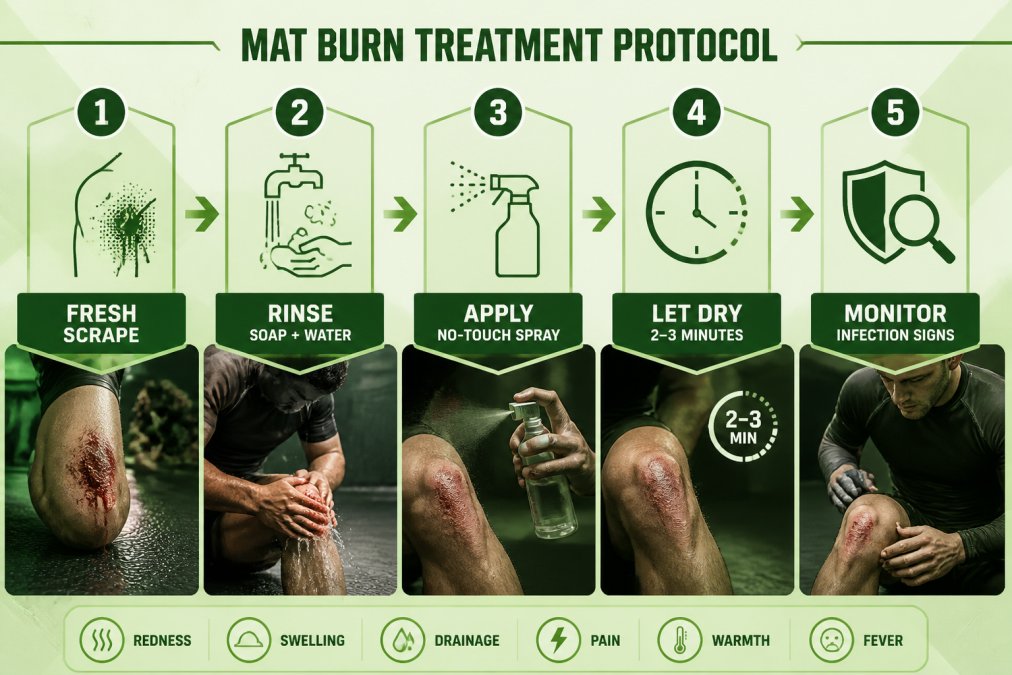
Step 1: Rinse with soap and water. Use cool running water and mild soap. Gently wash the burned area. Remove any visible dirt, sweat, or mat fibers. Pat dry with a clean towel.
Step 2: Apply no-touch spray. Once the area is dry, spray an antimicrobial formula directly onto the burn. NutriCore Vital is formulated with all-natural ingredients selected for their antibacterial and antifungal properties.
Step 3: Let it dry. Do not wipe or rub the spray. Allow it to air-dry for 2-3 minutes. This gives the formula time to absorb and form a protective barrier.
Step 4: Monitor for signs of infection. Watch the wound over the next 24-48 hours. Mild redness and slight swelling are normal. Increasing redness, warmth, pus, or spreading inflammation are not.
Step 5: Reapply as needed. Follow the product directions. Most no-touch sprays are applied 2-3 times daily until the wound begins to heal visibly.
Key Takeaway
The difference between a scrape that heals cleanly and one that gets infected often comes down to speed. Treat the wound within the first hour after training. The earlier you apply antimicrobial care, the lower your infection risk.
Covering Scrapes for BJJ Training: Protection and Return
Once you've treated a scrape, the question becomes: when can you return to the mats?
The answer depends on the wound's severity. A closed scrape, one that is no longer oozing or draining, can often be covered and trained on within 24-48 hours.
Covering a scrape properly is critical. You need something that protects the wound from mat contact, sweat, and bacteria without trapping moisture underneath.
Before covering, apply your no-touch spray and let it dry completely. Learn evidence-based staph prevention strategies to make informed decisions about safe mat return. Then apply the liquid bandage or spray plaster according to product directions.
Topical Scar Treatment Products for Wounds research notes that silicone gel products are effective for preventing pathologic scars and improving mature scars, though further high-quality studies are needed.
If you're training before a scrape is fully closed, communicate with your training partners. Let them know you have an open wound. Most gyms have rules about training with open cuts. Respect those rules.
[Link to companion article: Heal Mat Burns and Skin Abrasions: Step-by-Step Care for detailed aftercare guidance beyond the initial treatment phase.]
All-Natural NutriCore Vital Recovery Spray →
Early Signs of Staph Infection on Skin
Not every scrape becomes infected. But some do. Knowing the early warning signs lets you catch an infection before it becomes serious.
Staph infections on the skin often start with redness and warmth around the wound. You might notice the area feels hot to the touch. Swelling usually follows. The wound may begin to ooze pus, a thick, yellowish or greenish discharge. Some people experience pain that increases rather than improves over 24-48 hours.
Other signs include:
- Red streaks extending from the wound
- Swelling in nearby lymph nodes
- Fever or chills
- Pus-filled bumps or boils around the original scrape
If you notice any of these signs, stop training immediately. Do not return to the mats. See a healthcare provider. Staph infections can spread quickly, and early treatment prevents complications.
The best approach is prevention. This is where consistent use of antimicrobial wound spray makes a real difference. Applying NutriCore Vital 2-3 times daily during the first week after a scrape helps reduce infection risk. The formula's tea tree oil and apple cider vinegar address the bacterial threats common in grappling environments.
[Link to detailed guide: How to Stop Recurring Staph Infections: 7 Steps That Work for comprehensive prevention and treatment strategies.]
Watch Out
If you develop a fever, see spreading redness, or notice pus draining from a scrape, seek medical attention immediately. Do not self-treat severe infections. Staph can progress quickly, and professional care is essential.
No-Touch Spray vs. Traditional Wound Care: What Works
The choice between no-touch spray and traditional wound care comes down to application method and effectiveness.
Traditional wound care, balms, creams, and ointments, requires you to apply the product by hand. You rub it into the wound, which causes pressure and additional pain. The benefit is that you can see what you're doing and feel the product being absorbed. The downside is contact with an open, painful wound.
No-touch spray eliminates hand contact entirely. You point the bottle and spray. The formula reaches the wound without pressure. For athletes with multiple scrapes or sensitive skin, this is a significant advantage. NutriCore Vital delivers all-natural antimicrobial ingredients directly to the affected area. No rubbing. No spreading. No added trauma.
The ingredients matter. NutriCore Vital includes:
- Apple cider vinegar with the mother for acetic acid activity against bacteria
- Tea tree oil for documented effects on bacterial membrane function
- Helichrysum oil for antioxidant and skin-repair properties
- Frankincense oil for terpene-rich chemistry
[Link to product details: NutriCore Vital Recovery Spray Ingredients explains why each ingredient earns its place in the formula.]
For comparison, traditional balms like Regenerate RX offer rich conditioning and moisture retention. They're suitable for wounds that are already healing and need nourishment. For fresh scrapes, the no-touch approach offers antimicrobial defense without the pain of application.
| Care Method | Application | Best For | Key Advantage |
|---|---|---|---|
| No-touch spray | Point and spray | Fresh scrapes, multiple wounds | No contact, no pressure |
| Liquid balm | Apply by hand | Healing wounds, skin conditioning | Rich nourishment, visible coverage |
| Liquid bandage | Paint on with brush | Closed scrapes before training | Protective seal, flexible barrier |
Aftercare and Training Decisions
Once you've treated a scrape and protected it for training, the focus shifts to aftercare. This is where most athletes make mistakes.
The first week after a scrape is critical. Continue applying antimicrobial spray 2-3 times daily. Keep the area clean. Avoid exposing it to unnecessary friction or pressure. If you're training, keep the wound covered.
Around day 7-10, the scrape should begin to form a crust or scab. This is a good sign. It means the wound is healing. Do not pick at the scab. Do not scratch it.
By week 2-3, most scrapes are significantly improved. The skin begins to regenerate underneath the crust. At this point, you can reduce spray application to once daily or as needed.
Training decisions depend on wound severity:
- Closed scrape with no oozing: Can train immediately if covered with liquid bandage
- Open or draining wound: Wait 24-48 hours minimum. Cover before returning to mats.
- Deep abrasion or cut: Wait until bleeding stops and a protective crust forms. This typically takes 3-5 days.
- Signs of infection: Do not train. Seek medical attention.
The key is honesty about your wound's condition. Pushing to train too early risks infection or deeper injury.
Key Takeaway
Aftercare is just as important as initial treatment. Most infections develop during the first 7-10 days after injury. Consistent application of antimicrobial spray during this window helps reduce your risk.
Scrapes and mat burns are part of jiu-jitsu. They don't have to become infections. The difference is how you respond in the first hour after injury. Clean the wound with soap and water.
NutriCore Vital delivers all-natural defense without contact pressure. Its formula of apple cider vinegar, tea tree oil, and skin-conditioning ingredients fights staph and MRSA while supporting healing. Get started with NutriCore Vital Recovery Spray and treat your scrapes the way combat athletes should: fast, effective, and pain-free.

Frequently Asked Questions
How do you clean a scrape from jiu-jitsu?
Rinse the scrape immediately with soap and water to remove sweat, debris, and bacteria. Use cool running water and mild soap, gently patting dry with a clean cloth. Avoid rubbing. Once clean and dry, apply a no-touch wound spray like NutriCore Vital to prevent infection without adding pressure to the tender area. Clean the scrape as soon as you can after training, ideally before sweat and mat contact dry on the wound.
Can you use no-touch wound spray on an open cut?
Yes, no-touch wound spray is designed for open wounds. The no-touch application means you spray the formula directly onto the affected area without hand contact, which is ideal for painful, open scrapes and mat burns. This delivery method prevents additional trauma to the wound while still providing antimicrobial and skin-conditioning care. Always clean the wound first with soap and water, then apply the spray according to product directions.
What are early signs of a skin infection after a scrape?
Watch for increasing redness, warmth, or swelling around the scrape beyond the first 24 hours. Signs of infection include pus or yellow drainage, red streaks extending from the wound, fever, or enlarged lymph nodes. Staph and MRSA can develop quickly in grappling environments. If you notice these signs, stop training and seek medical attention. Early intervention prevents serious complications and keeps you off the mats safely until the infection clears.
Should you cover a scrape before training jiu-jitsu?
Yes, cover scrapes before returning to training. Protect the wound from mat contact, sweat, and bacteria. If the scrape is still oozing or open, avoid training until it has begun to close and form a protective barrier. Many gyms require covered wounds before returning to the mats. Once healed enough to train, keep the area covered to prevent reinjury and reduce contagion risk to training partners.
