
Are Natural Skin Balms Effective? Regenerate RX Tested
Editorial Team
Last Updated: November 8, 2026
Quick Summary
Natural skin balms are generally used to seal moisture into the skin and protect it from further dryness. Because a balm is thick and water-free, it stays on longer than a cream, which suits cracked hands, rough heels and skin stressed by friction. Their effects on specific concerns depend on the formula and the individual.
- A balm is a thick, water-free product that stays on skin longer than a cream.
- Balms suit cracked hands, rough heels and friction-stressed skin.
- A balm supports recovery but cannot repair a badly damaged skin barrier.
- Natural does not automatically mean gentler, since plant oils and fragrances can irritate skin.
- Patch test a new balm on the inner forearm for 24 hours before wider use.
Is a natural balm right for your training?Zombie Sport Co makes all-natural balms and sprays for athletes dealing with dry, cracked and friction-damaged skin.
Shop Regenerate RX
Table of Contents
- What a Natural Skin Balm Does and Doesn't Do
- How Balms Protect a Damaged Skin Barrier
- Natural Skin Balm Ingredients: What the Evidence Shows
- Natural Balm for Dry Skin vs Cream: Which Works Better
- How to Use a Skin Balm and Patch Test First
- Choosing Your Balm for Training and Recovery
- Frequently Asked Questions
What a Natural Skin Balm Does and Doesn't Do
Natural skin balms are generally used to seal moisture into the skin and protect it from further dryness. Beyond that, the claims get murkier, and that is where most shoppers get confused.
A balm is a thick, water-free product. It usually blends waxes and plant oils, which create a protective layer on top of the skin.
Here is what a balm generally does not do:
- It does not replace medical treatment for a spreading infection, a deep wound or a rash that keeps coming back.
- It does not make every ingredient safe for every person. Natural does not mean risk-free.
- It does not work the same way on every skin type or concern.
A 2023 review of plant-based skin care notes that plant oils are used in cosmetic and medical settings for their protective-barrier function and their role in moisture retention, as Study of plant-based cosmeceuticals and skin care describes.
How Balms Protect a Damaged Skin Barrier
Your skin barrier is the outer layer that keeps water in and germs out. When it cracks from cold air, friction, sweat or repeated scrubbing, moisture escapes faster and irritants get in more easily.
For athletes, this matters most in two places: mats, where skin rubs against skin and fabric, and gear, where straps and grips wear down the top layer. Keeping the barrier intact is a practical way to reduce the chance of a small abrasion becoming a bigger problem.
A balm cannot repair a barrier that is badly damaged. It supports recovery, but it works best on minor dryness, chapping and small scrapes that are already clean.
Natural Skin Balm Ingredients: What the Evidence Shows
The ingredient list is where "natural" gets tested. Each ingredient does something different, and it is worth knowing what, so you can judge a product yourself instead of trusting the label.
Plant Oils, Beeswax, and Shea Butter
- Plant oils such as coconut oil help the skin hold moisture and support its barrier. Their occlusive and emollient properties are well established in cosmetic science.
- Beeswax forms the protective surface coverage that gives a balm its staying power. It is what keeps the product on the skin through friction and sweat.
- Shea butter adds rich conditioning, which softens dry, stressed skin and improves the feel of the balm.
Research on these ingredients is generally about moisture and barrier function.
Our Regenerate RX balm combines these ingredients with apple cider vinegar and tea tree oil, selected for their antibacterial, antiviral, and antifungal properties.
How to Judge the Evidence Behind Any Balm
Most balm marketing makes broad effectiveness claims without showing the evidence underneath. Here is how to separate the three levels of proof you will encounter, so you can compare formulations fairly instead of relying on labels such as clean or organic.
- Ingredient-level research. Studies on a single oil or wax describe how that ingredient behaves in a lab or in a controlled setting. This is useful background, but it does not prove that a finished product containing that ingredient works the same way on your skin.
- Product-specific clinical testing. This is testing done on the finished balm, on real people, with measured outcomes. It is the strongest evidence a cosmetic product can offer.
- Marketing claims. Words like "clinically inspired," "dermatologist reviewed," or "natural healing" are not the same as testing. They describe positioning, not results.
A practical checklist for comparing two balms side by side:
- Read the full ingredient list, not just the front label. Ingredients are listed in descending order of concentration.
- Note whether fragrance or essential oils appear, since these are common irritants for sensitive skin.
- Check how occlusive the formula is. A higher wax content stays on longer but feels heavier.
- Match the intended use to your situation: everyday dryness, friction-prone skin, or minor abrasions.
- Look for any statement of product testing rather than ingredient-level claims alone.
Watch out: a long list of botanical extracts can read as impressive while adding irritation risk without adding proven benefit. Fewer, well-understood ingredients are often the safer bet for reactive skin.
Why Natural Does Not Automatically Mean Gentler
This is the point most "natural" marketing skips. Natural skincare products can contain allergens linked to contact dermatitis, and plant-based oils can irritate the skin just as synthetic ingredients can. Fragrance and essential oils are among the most common culprits.
Neither natural nor synthetic formulations are automatically better. The right choice depends on your skin, your sensitivity history, and what the product is actually meant to do.
Natural Balm for Dry Skin vs Cream: Which Works Better
For dry skin, the choice usually comes down to timing and texture.
- Cream works well for everyday hydration, especially on the face and body, because it spreads easily.
- Balm works better when skin is cracked, rough or exposed to wind, cold or friction, because it stays on longer.
Many people use both: a cream for daily routine and a balm for problem spots. A cream rarely hurts, but if a balm feels greasy on your face, a lighter cream may suit you better.
A survey reported by Market.us found that 59% of U.S. respondents prefer skincare made with natural or organic ingredients, according to Market.us skincare statistics 2026. That reflects preference, not proof that natural balms outperform creams.
How to Use a Skin Balm and Patch Test First
Patch testing is the step most people skip, and it is the one that prevents most bad reactions. Before using any new balm on a larger area:
- Clean and dry a small patch of skin, such as the inner forearm.
- Apply a small amount and leave it for 24 hours without washing it off.
- Watch for redness, itching, swelling or a rash.
- If nothing happens, you can use it more broadly. If irritation develops, stop using it and note the ingredient list for future reference.
Once the patch test is clear, apply a thin layer to clean, dry skin as needed.
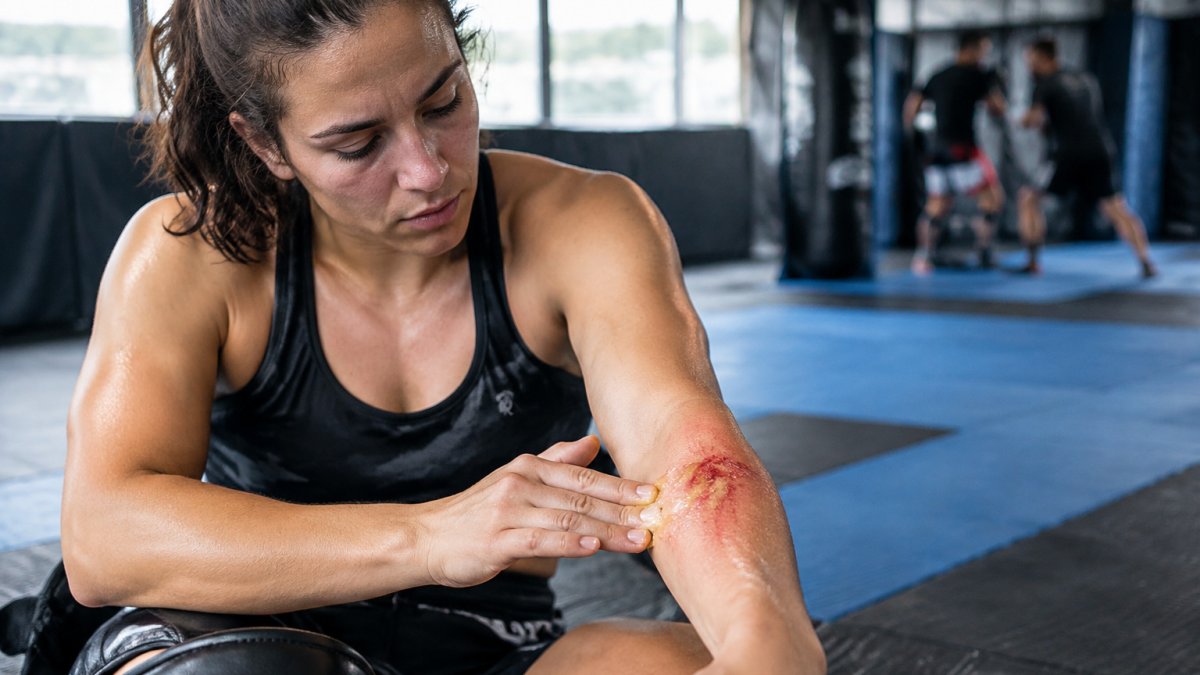
For a fresh abrasion, the priority is cleaning it as soon as you can.
!A martial arts athlete in a training gym dabbing a small amount of balm on a forearm abrasion between rounds, shot at a dynamic angle with gym mats in the background, bright overhead gym light
When a Balm Is Not Enough
A cosmetic balm supports the skin; it does not treat every condition. Set expectations before you rely on one.
- Persistent rashes or eczema flares that keep returning need a medical assessment, not more balm.
- Spreading redness, warmth, pus, fever, or a wound that is not closing are signs to stop using the product and see a doctor.
- Deep wounds, puncture injuries, or bites are outside what a balm is designed for.
- A reaction that worsens after application means stop and get advice, especially if swelling or blistering appears.
If a minor dry patch does not improve after two weeks of consistent use, or if anything is getting worse, seek medical advice.
If you are ready to try one, the All-Natural Regenerate RX Protect and Restore Balm is the product this guide is based on. For a broader look at infection prevention, read Prevent Staph in BJJ: Complete Defense With Regenerate RX.

The steps below cover the patch test and application routine the article describes.
| Step | What to do | Time or frequency |
|---|---|---|
| Clean the patch | Clean and dry a small area, such as the inner forearm | Before first use |
| Apply a small amount | Apply a small amount and leave it on | Leave for 24 hours |
| Watch for reactions | Check for redness, itching, swelling or rash | Over 24 hours |
| Broader use | Use more broadly only if no irritation appears | After a clear patch test |
| Application amount | Start with about a pea-sized amount for a small area | Add more only if still dry |
| Reapply | Reapply after sweating, showering or friction | As needed |
Choosing Your Balm for Training and Recovery
Choose based on your situation, not on the word "natural" alone.
- For mat training and abrasions: a balm with a protective layer and conditioning ingredients suits you best.
- For dry, cracked hands between sessions: a richer balm or a cream may be enough.
- For sensitive skin: patch test first and read the full ingredient list, including the fragrance and essential-oil content.
Balms are most useful as part of a routine: clean skin, a patch test, a thin application, and a check for irritation over the next few days.
If you want to see how this works in practice, the NutriCore Vital recovery spray is part of the range.
Get started with Zombie Sport Co's Regenerate RX if you want a balm built for training-related skin care, with the ingredients explained so you can judge them yourself.
Frequently Asked Questions
Are natural skin balms effective for dry skin?
Natural balms are occlusive and help retain moisture, which is why they are often used on dry, chapped skin. Plant oils are commonly used to support moisture retention. Expect softening and barrier support rather than a cure for chronic dryness. If dryness persists for several weeks despite consistent use, a dermatologist can help identify the cause.
Can natural skin balms cause irritation or allergic reactions?
Yes. Natural does not mean non-allergenic. Natural skin care products can contain allergens, and plant-derived ingredients such as essential oils are common triggers. Before using any balm on broken or sensitive skin, apply a small amount to an inconspicuous area, such as the inner forearm, and watch for 24 to 48 hours. Stop use if redness, itching, or swelling develops.
Are balms or creams better for dry skin?
Balms are usually thicker and more occlusive than creams, so they hold moisture in longer and suit very dry or rough patches such as cracked hands, heels, or elbows. Creams contain more water and spread more easily, which makes them a better daily option for large areas. Many people use a cream for everyday moisturizing and a balm for targeted areas at night or after training.
When should you see a doctor about a skin problem instead of using a balm?
See a doctor for bites, punctures, deep cuts, wounds that will not stop bleeding, signs of infection such as spreading redness, warmth, pus, or fever, or any rash that persists or worsens. Balms can support minor scrapes and dryness, but they do not replace medical evaluation for serious injuries or suspected staph, MRSA, or fungal infections.
