

6 Wound Spray Rules for Sensitive Skin: NutriCore Vital
Editorial Team
Last Updated: October 25, 2026
Quick Summary
A wound spray for sensitive or tender skin cleans without touching the broken surface, so you flush debris away instead of scrubbing. Spray from a short distance in two or three gentle passes, then let the wound air dry. Choose a fragrance-free, pH-balanced formula and patch-test it first.
- Spray from a short distance and never scrub the wound bed.
- Saline is isotonic, so it does not sting delicate tissue.
- Avoid fragrance, dyes, parabens, alcohol denat., and high-concentration essential oils.
- Use non-adherent pads or silicone-backed dressings that peel off without pulling skin.
- Apply firm pressure for ten minutes on blood thinners before spraying.
Table of Contents
- Why a Wound Spray Beats Wiping on Tender Skin
- How to Clean a Minor Wound Without Irritating It
- Saline, Antiseptic, or Wound Healing Spray: How to Choose
- Reading the Label When Your Skin Reacts to Everything
- Wound Dressing for Sensitive Skin: What to Put Over the Spray
- Wound Care for Fragile Skin: Kids, Older Adults, and Bruised Bodies
- When a Tender Wound Needs a Doctor, Not a Spray
- Add NutriCore Vital to Your Gym Bag Before the Next Mat Session
- Frequently Asked Questions
Why a Wound Spray Beats Wiping on Tender Skin
A wound spray for sensitive or tender skin delivers cleansing liquid without touching the broken surface, which matters when even light pressure hurts. At Zombie Sport Co, we built our no-touch recovery spray around that exact problem: mat burns, scrapes, and raw skin that flinch at the first dab of a cloth.

Here is the core argument. Most wound care fails not because the product is wrong, but because the delivery hurts. People skip cleaning. Then dirt stays in the wound.
The global wound sprays market was valued at US$542.5 million in 2026 and is projected to reach US$738.2 million by 2033, according to Persistence Market Research's wound sprays market forecast. That growth tracks a simple clinical reality: sprays reach areas a wipe cannot.
What Sensitive and Fragile Skin Actually Needs
Fragile skin needs four things from a cleanser: no contact, no harsh additives, a pH-balanced formula, and a delivery method that flushes rather than scrubs. Sensitive skin is skin that reacts fast to friction, fragrance, or dyes. Fragile skin is thinner and tears more easily, common in older adults and anyone on blood thinners.
A 2022 review in PubMed Central on spray products for skin regeneration describes skin sprays as a promising approach and notes their potential to deliver treatments over large wound areas. That is the mechanical advantage: coverage without contact.
How to Clean a Minor Wound Without Irritating It
Cleaning a minor wound without irritation means flushing it with a gentle spray from a short distance, letting the liquid carry debris away, and never scrubbing the wound bed. For a deeper walkthrough, see the No-Touch Wound-Care Spray Guide. Do this within minutes of the injury, before dirt dries into the tissue.
Step by Step: Spray, Flush, and Let It Dry
Follow this sequence for minor cuts, scrapes, and mat burns:
- Wash your hands with soap and water. Ten seconds of scrubbing.
- Inspect the wound in good light. Look for embedded grit or debris.
- Spray from a short distance to flush the surface. Let the liquid run off.
- Repeat two or three passes until the wound bed looks clean.
- Pat the surrounding skin dry. Leave the wound itself to air dry.
- Cover if needed with a dressing that will not stick.
Watch out: spraying at high pressure directly into a deep wound can push debris deeper. Keep the nozzle back and use a gentle stream.
Saline, Antiseptic, or Wound Healing Spray: How to Choose
Choose saline for plain irrigation, antiseptic for a targeted antimicrobial step, and a natural wound healing spray when you want cleansing plus skin conditioning in one no-touch product. Each has a place, and the right pick depends on the wound and the skin around it.
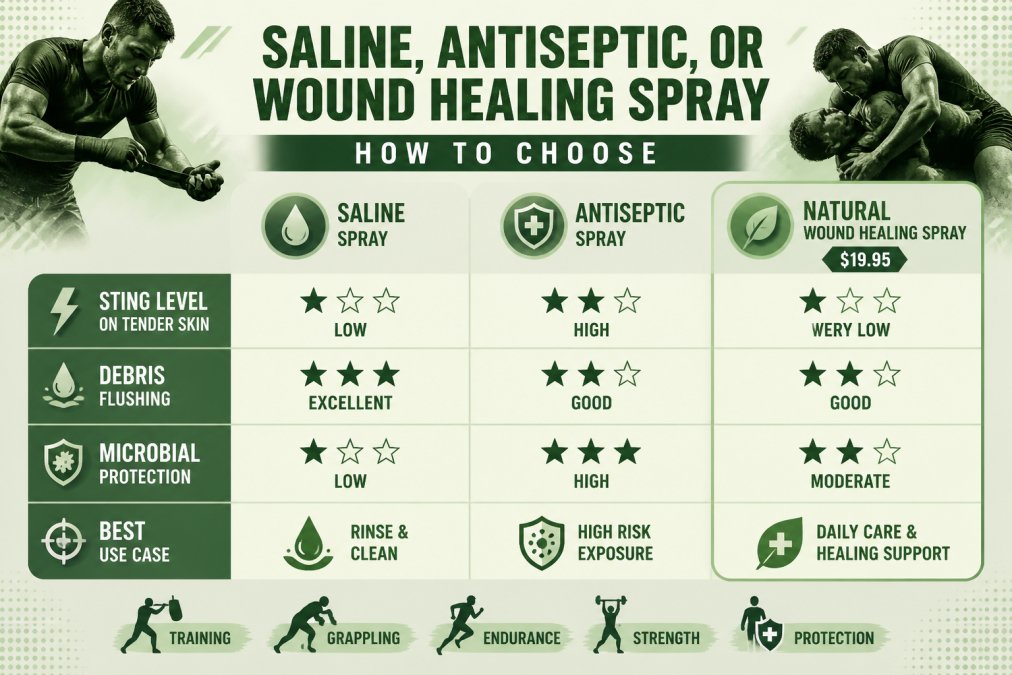
Saline is an isotonic solution: it matches the salt balance of your body, so it does not sting. That makes it the safest flush for delicate tissue. Its limit is that it cleans and nothing more.
Antiseptic products kill germs on contact but can sting and dry out fragile skin with repeated use. A 2015 evaluation of an antimicrobial spray dressing, recorded in the PubMed study record, reported reduced pain during recovery with antibacterial protection equivalent to the control.
Here is how the three compare on the factors that matter most:
| Type | Sting on Tender Skin | Flushes Debris | Microbial Protection | Best For |
|---|---|---|---|---|
| Saline | Low | Yes | None | First rinse, delicate tissue |
| Antiseptic | Higher | Varies | Strong | Targeted germ control |
| Natural healing spray | Low to moderate | Yes | Formula-dependent | Daily care plus conditioning |
Our pick for daily training care is the natural spray column. It cleans, conditions, and skips the sting of repeated antiseptic use.
Reading the Label When Your Skin Reacts to Everything
Label reading for reactive skin is not about spotting a single bad word. It is about matching the product's intended use, directions, and full ingredient list to the wound in front of you. Most guides stop at "fragrance-free." That is not enough when your skin reacts to everything.
Start with the intended-use panel. A product labeled for intact skin is not the same as one labeled for minor cuts and scrapes. If the label says "external use only" and "do not use on deep or puncture wounds," believe it. A spray built for intact-skin conditioning should not go into an open abrasion.
Then read the directions for three things: spray distance, number of passes, and whether the product says to rinse. A label that says "apply generously and let dry" is telling you it is a leave-on product. A label that says "irrigate and pat dry" is telling you it is a flush. Those are different jobs.
Here is the irritant checklist to run before the first spray:
- Fragrance and parfum, the most common contact triggers on broken skin.
- Dyes such as FD&C colors, cosmetic, not clinical.
- Parabens (methyl-, propyl-, butyl-), preservatives some people choose to skip.
- Alcohol denat. and isopropyl alcohol, fast-drying, but drying and stinging on fragile tissue.
- Essential oils at high concentration, tea tree, eucalyptus, and peppermint are natural and can still irritate open skin.
- Surfactants like sodium lauryl sulfate, foaming agents that are not needed in a wound flush.
Look for these terms instead:
- Fragrance-free and dye-free on the front panel.
- pH-balanced in the claims.
- Isotonic if you want a saline-style match to skin.
- A short ingredient list you can read aloud.
Watch Out
"Natural" is not a safety claim. Tea tree oil is natural and can irritate broken skin at high concentrations. Read the full list, not the badge.
Finally, patch-test anything new. Spray a small area of intact skin near the wound, wait a few minutes, and watch for stinging that does not fade or redness that spreads. That two-minute step is the cheapest sensitivity test you will ever run.
All-Natural NutriCore Vital Recovery Spray →
Wound Dressing for Sensitive Skin: What to Put Over the Spray
The right wound dressing for sensitive skin is one that will not stick to the wound bed: a non-adherent pad, a silicone-backed dressing, or a thin protective balm layer under gauze. Adhesive bandages on fragile skin can tear the surrounding tissue when removed.
After the spray dries, a light balm layer can protect the surface and keep it from drying out. Our Regenerate RX protect and restore balm is built for that step: a small amount over clean, dry skin, following the product directions.

Watch out: sealing a wound under an airtight dressing before it is clean traps bacteria. Spray first, let it dry, then cover.
Wound Care for Fragile Skin: Kids, Older Adults, and Bruised Bodies
Wound care for fragile skin changes with age and condition. Children have thin skin and fast reactions to stinging products. Older adults have slower healing and thinner tissue that tears under tape. Anyone on blood thinners bruises and bleeds more from minor knocks.
Children. A child's skin is thinner and more permeable, so a sting registers faster and louder. Use the gentlest flush you can, keep the spray a hand's width back, and skip antiseptic on every change. Distraction matters: spray while they count to five, not while they watch.
Older adults. Thinner tissue and slower healing mean the dressing is often the bigger risk than the wound. Adhesive bandages on fragile skin can tear the surrounding tissue when removed.
People on blood thinners. Minor knocks bleed longer and bruise more. Apply firm pressure for a full ten minutes before spraying, then flush gently and cover. Do not keep lifting the dressing to check; each lift restarts the clot.
Adjust the routine in three ways for all three groups:
- Use the gentlest flush you can, and skip antiseptic on every change.
- Choose dressings that peel off without pulling skin.
- Check the wound daily for spreading redness or warmth.
Aftercare is where most guides stop, and where fragile skin needs the most help. After the spray dries, a light balm layer can protect the surface and keep it from drying out.
Pro Tip
Keep a small "fragile skin kit" in the gym bag: a no-touch spray, non-adherent pads, paper tape, and a light balm. The kit you actually carry is the one that gets used.
The same no-touch logic applies to all three groups. Less contact means less pain and less tissue damage.
When a Tender Wound Needs a Doctor, Not a Spray
Some wounds need medical care, not a spray. Get seen if a wound is deep, gaping, or bleeding that will not stop after ten minutes of firm pressure. Also go in for punctures, animal bites, or anything with embedded debris you cannot flush out.
Signs of infection are the other red flag:
- Spreading redness or streaks
- Increasing warmth or swelling
- Pus or a bad smell
- Fever or chills
For athletes in shared-surface sports, infection risk runs higher. Close-contact training spaces carry staph and ringworm, and a small scrape is an open door. A spray helps with cleaning, but it does not replace a doctor when infection is already setting in.
Add NutriCore Vital to Your Gym Bag Before the Next Mat Session
The best wound care is the care you actually do. A spray you can point and use in ten seconds beats a perfect routine you skip because it hurts. That is the whole case for keeping a no-touch wound spray for sensitive or tender skin within arm's reach of your gear.
Our NutriCore Vital is the product we built for this: an all-natural formula with apple cider vinegar, tea tree oil, helichrysum, and frankincense, delivered without spreading balm by hand over open skin. It is third-party laboratory certified and priced at $19.95, with free shipping on topical products.
Kouros Kc Danesh, a Jiu Jitsu competitor, put it plainly: "It honestly works better than any care I have ever used."
Frequently Asked Questions
What is the best wound dressing for sensitive skin?
Look for a dressing that lifts off without pulling at the healing edge: silicone-backed adhesive pads, non-stick film dressings, or a plain gauze pad held in place with paper tape. Avoid strong adhesive bandages on fragile or recently sprayed skin, since the adhesive can tear delicate tissue when removed. Change the dressing daily or whenever it gets wet, and spray the wound again with a wound spray before re-covering so the surface stays clean between changes.
How do you clean a minor wound without irritating sensitive skin?
Rinse first with lukewarm water or saline to float dirt and debris off the surface, then pat the surrounding skin dry rather than rubbing the wound itself. Skip alcohol, hydrogen peroxide, and iodine, which sting and can slow healing. A no-touch wound spray lets you deliver care without pressing a cloth or balm into an open cut. NutriCore Vital is sprayed directly on the area three times daily, following the product directions, and left to dry.
When should a tender wound be checked by a healthcare professional?
Get medical attention if the wound is deep, gaping, bleeding heavily, or caused by an animal bite or a dirty object. Also seek care if redness, swelling, warmth, or pain spreads in the days after cleaning, or if you develop a fever. People with diabetes, poor circulation, or a weakened immune system should have wounds checked early rather than waiting. A spray handles minor cuts and scrapes; it is not a substitute for closing a wound that needs stitches.
Does a wound healing spray actually speed up recovery?
Research points in that direction but with limits. A 2022 review in PubMed Central describes skin sprays as promising for delivering care over large wounds.
Your next mat session will leave a scrape somewhere. The question is whether you clean it fast and gently, or let it sit until it stings. Get started with Zombie Sport Co and keep a no-touch spray in your bag, ready before the next break in skin.
