
Regenerate RX vs NutriCore Vital: Spray or Balm for Athletes
Editorial Team
Last Updated: October 31, 2026
Quick Summary
A wound care spray applies without touching the injury, which suits tender abrasions and mat burn, while a wound care balm stays put as a protective layer for high-friction spots. Both Zombie formats contain acetic acid, so they clean the wound as they go on. Choose the format based on the wound, its location, and what will rub against it.
- A spray goes on without touch, which helps when skin is tender.
- A balm coats the surface and suits areas where gear rubs, like knees and elbows.
- Both Zombie formats use apple cider vinegar with the mother, containing acetic acid.
- Let a spray dry or a balm settle before taping, to avoid trapping moisture or weakening adhesion.
- Seek medical care for deep, gaping, or bleeding wounds, puncture wounds, bites, or signs of infection.
Table of Contents
- Wound Care Spray vs Wound Care Balm: The Core Difference
- How Wound Sprays and Balms Work on Training Injuries
- Saline Spray for Wounds vs Antiseptic Spray: What Athletes Should Know
- Using Wound Care Under Athletic Tape and Gear
- Choosing Your Format for Your Next Session or Competition
- Frequently Asked Questions
Wound Care Spray vs Wound Care Balm: The Core Difference
Athletes often ask whether a wound care spray or a wound care balm is the better choice after a training injury. The honest answer is that the format matters less than what goes into it and how it fits your routine. Zombie Sport Co builds both formats around the same core idea: every product is designed to clean and protect skin that has broken during training.
The difference between the two formats comes down to delivery. A spray goes on without touch, which matters when skin is tender or when you want to avoid spreading bacteria from your hands. A balm stays put, coats the surface, and suits areas where you want a protective layer.
How Wound Sprays and Balms Work on Training Injuries
Most training injuries are minor cuts, scrapes, and abrasions that come from mat burn, shared equipment, or contact with an opponent's skin. Both formats aim to keep these wounds clean and moist enough to heal without drying out or cracking.
A spray works by covering the wound in a thin film from a short distance. Because nothing touches the area, there is no hand contact during application. A balm works by sitting on the surface as a barrier.
Zombie's Regenerate RX Protect and Restore Balm and NutriCore Vital Recovery Spray both use apple cider vinegar with the mother as a core ingredient. With apple cider vinegar at the heart of both formats, choosing between a balm and a spray also raises the broader question of pain relief spray or roll-on for targeted application.
Saline Spray for Wounds vs Antiseptic Spray: What Athletes Should Know
Zombie's NutriCore Vital Recovery Spray is built around antibacterial, antiviral, and antifungal ingredients rather than saline alone. It is formulated with antibacterial, antiviral, and antifungal ingredients for staph and ringworm concerns that combat athletes face. If you are cleaning a fresh cut with running water, that remains a sensible first step. The spray then covers the wound and supports the next stage of care.
Using Wound Care Under Athletic Tape and Gear
Tape, guards, pads, and compression gear change the wound-care decision because they trap moisture, add shear force, and sit directly on top of whatever you applied. The format you choose affects three things: whether the product stays where you put it, whether tape and dressings still stick, and whether the wound gets re-irritated when gear shifts.
How each format behaves under gear
- Spray: Lays down a thin, even film with no rubbing. Because there is no physical contact, it is the better choice over a fresh, tender abrasion or a mat burn where touching the surface would hurt or disturb the wound. The trade-off is dry time, most sprays need a short window to stop feeling wet before tape, a dressing, or a pad goes on top. Taping over a still-wet spray can trap moisture and weaken adhesion.
- Balm: Sits on the surface as a coating and stays put, which is why it suits high-friction spots like knees, elbows, and the back of the heel where gear rubs. The trade-off is residue: a heavy layer can interfere with tape adhesion and can soften adhesive on dressings. Apply a thin layer, let it settle, and blot any excess before taping.
A practical taping sequence
- Apply the product to clean, dry skin, Zombie's acetic acid base cleans the wound as it goes on.
- Give the product a moment to stop feeling wet (sprays) or to settle (balms).
- Blot any excess balm with a clean gauze pad so the skin surface is tacky, not slick.
- Apply a non-stick dressing over the wound if the area will be under direct pressure, then tape over the dressing rather than directly over the product.
- After training, remove gear, check the area, and reapply as your product directions say.
Where athletes get this wrong
A common pattern is applying a thick balm and taping straight over it, then finding the tape rolls or lifts mid-session. The opposite mistake is spraying a wound and immediately covering it, which traps moisture against the skin. Neither format is 'better' under gear, the balm wins on friction protection, the spray wins on no-touch application over tender skin, and both need a dry or settled surface before anything adhesive goes on top.
All-Natural NutriCore Vital Recovery Spray →
Pro Tip
Keep a small roll of non-stick dressing and tape in the same pouch as your wound care so the product-then-dressing-then-tape sequence is one motion at the field or mat side.
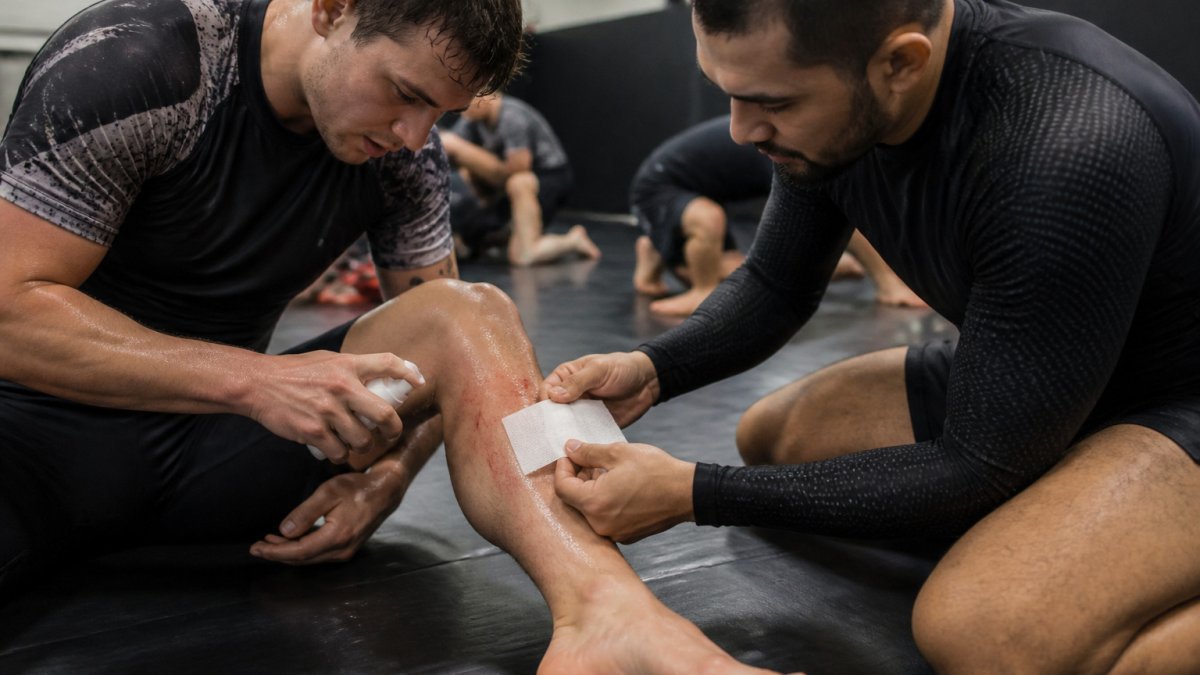
The two formats behave differently under gear, so here is how each one compares once tape, pads, or dressings go on top.
| Format | Best for | Key difference |
|---|---|---|
| Spray | Tender abrasions and mat burn | No-touch application; needs dry time before taping |
| Balm | High-friction spots like knees and elbows | Stays put as a protective layer; heavy residue can weaken tape adhesion |
| Spray then balm | Broad graze that rubs against gear | Spray cleans without contact; thin balm adds friction protection |
Choosing Your Format for Your Next Session or Competition
Choosing between a spray and a balm depends on the wound, where it sits, and what the next session will do to it.
By wound type
- Mat burn and surface abrasions: Spray. The area is broad and tender, and no-touch application avoids disturbing the surface. Follow with a thin balm layer if the spot will rub against gear.
- Friction blisters and hot spots: Balm. A coating reduces shear against socks and shoes; a spray alone does not cushion friction.
- Small cuts and nicks: Either format works. Spray if the cut is in a hard-to-reach spot; balm if it sits where tape or a pad will press on it.
- Graze on a knee, elbow, or hip: Balm for the protective layer, spray first if the wound needs cleaning without contact.
By situation
- Field-side or mat-side first aid: Spray. It reaches the wound without hands, which matters when your hands are not clean and clean water is not at hand. Zombie's acetic acid base cleans the wound as it is applied.
- Gym bag and travel kit: One of each. The spray handles no-touch cleaning; the balm handles friction protection.
- Competition day: Match the format to what will be on top of the wound. Under tape and pads, a settled balm plus a non-stick dressing; over an exposed abrasion between matches, a spray.
- Post-training care: Either format, applied after the area is checked and cleaned. Rinsing with clean water when it is available is fine.
Safety boundaries, when a format choice does not matter
No spray or balm substitutes for medical care. Seek evaluation for wounds that are deep, gaping, or bleeding heavily; wounds contaminated with dirt or debris that will not rinse out; puncture wounds; animal or human bites; wounds over a joint or on the face; signs of infection such as spreading redness, warmth, swelling, pus, or fever; and wounds that are not improving after several days.
The short version
Choose the spray when you need to clean and cover without touching the wound, or when clean water is not at hand. Choose the balm when the wound will rub against gear and needs a protective layer. Keep both in the bag and let the wound, the location, and the next session decide.

Key Takeaway
Spray for no-touch cleaning and hard-to-reach areas; balm for friction protection under gear. Both Zombie formats carry acetic acid, so cleaning happens with every application, even when the product is the only option you have.
Frequently Asked Questions
Is saline spray good for wounds?
Saline is a common choice for rinsing wounds and is widely used for gentle cleaning. It does not carry an antimicrobial ingredient, so it cleans without adding antimicrobial action. Athletes who train on shared mats often want a product that cleans and also addresses microbes on the surface. NutriCore Vital is formulated with antibacterial, antiviral, and antifungal ingredients and contains acetic acid, so each application cleans as it is applied.
Which is better for wound care, saline or antiseptic?
The answer depends on the wound and the setting. Saline is gentle and suited to rinsing debris. Antiseptic products target microbes on the skin. For training injuries on shared surfaces, many athletes want both actions together. Zombie's formulas include acetic acid, so each application cleans the wound as it goes on, which makes them a practical option when rinsing water is not available. Severe or deep wounds still need medical evaluation.
When should athletes use a wound care spray instead of a balm?
Sprays suit tender, irregular or hard-to-reach areas because they apply without hand contact. NutriCore Vital is designed for no-touch use on painful wounds. Balms suit areas where you want a protective layer, such as Regenerate RX for ongoing skin care through the day. Choose the format that matches the area and the moment.
When should an athlete get medical care for a wound?
Seek medical care for deep cuts, wounds that will not stop bleeding, wounds with spreading redness, warmth, swelling or pus, or any injury that shows signs of infection. Wounds caused by bites or contact with contaminated objects also warrant a professional opinion. Topical products support minor scrapes and abrasions, but they do not replace evaluation when a wound is serious or not improving.
Keep one format in your bag before your next session, and check your wounds after every training day. Zombie Sport Co makes both options so you can match the product to the injury, not the other way around.
